
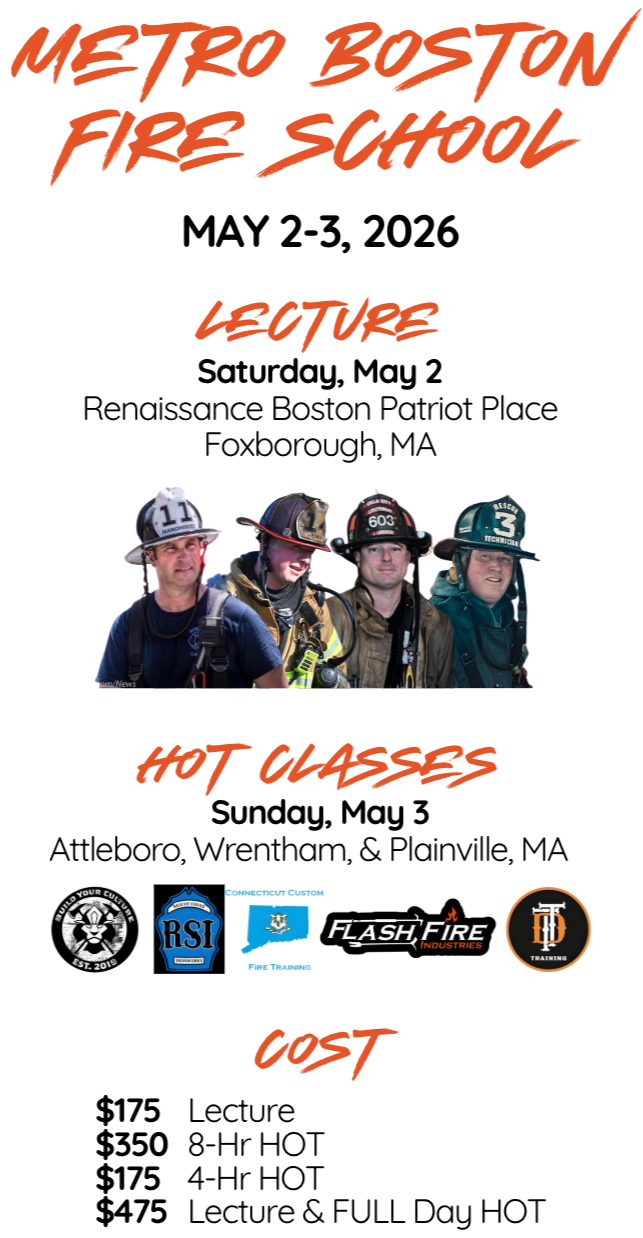
Saturday, May 2 - Foxborough, MA
1-Day Lecture Series
-
Maximizing Fireground Performance
Ever thought about the characteristics that separate a good firefighter from a truly great one? Is it years of experience? Being aggressive” Going to a bunch of conferences or training events? A salty fire helmet?
The best companies in your department, region or even across the country all have the same thing in common: mastery of the basics which are built off of attention to details. These members train tirelessly until they are unconsciously competent at the skills required to not only meet, but exceed the standards and expectations set forth by their organization. The people that we serve deserve that!
This dynamic lecture dives into different areas where the little details can help maximize fireground performance. From laying you gear out and masking up, the way you run lines, throw ladders, force a door, or package a downed firefighter, the details matter! We will talk about how this concept can be applied on and off the fireground to help overall efficiency and effectiveness when the clock is ticking. We will also discuss how to adopt change in your organization to create a fire first mentality where the details can influence positive change.
About Eric: Eric is a 23-year veteran of the fire service who began his journey as a volunteer of the Berlin Fire Company where he has held the ranks of Captain and Assistant Chief. While volunteering, he began his career with the Ocean Pines Fire Department, holding the rank of Lieutenant. Eric later transitioned to the District of Columbia Fire Department (DCFD) in 2014 where he is currently a Rescue Squad Technician assigned to Rescue Squad 3 in the Special Operations Battalion. Eric is also an instructor for Traditions Training and enjoys sharing his passion and knowledge with others. -
Dutton Street “Less Than Ten Seconds” My Near-Miss Story
First hand account of the Dutton St structure fire on Nov 6, 2021 with an emphasis on firefighter survival. The long journey to recovery, struggling with both the physical and mental effects. Lessons learned and what you and your department need to know when traumatic incidents hit your department.
About Steve: Steve started his fire service journey in 1992, graduating from the NH Fire Academy Recruit School. Earned his degree from NH Laconia Technical College in 1997 with AAS in Fire Science and was hired with the Manchester NH Fire Department in 1999. Currently Steve is a Battalion Chief running out of the department's headquarters at the Merrimack St Central Firehouse. He is also a Senior Staff Instructor with the NH Fire Academy and an IAFF Fire Ground Survival/FF Rescue Master Instructor.
-
Engine Company Operations During Civil Unrest
The threat of civil unrest is ever present in modern society. These events often result from elections, sporting events, trials, perceived injustices, or use of force cases. The ensuing fire duty can rapidly tax available resources and present unheard-of challenges to responding firefighters. As a result, engine companies must adjust their mindsets, strategies, and tactics to safely and effectively respond to these incidents. Attendees will examine scene security issues, building construction and occupancy features, attack line considerations, water supplies, and the effectiveness of past responses.
About Jon: Jon Hall has more than 25 years of fire service experience. He currently is a captain with the St. Paul, MN, Fire Department assigned to Engine Company 14. Hall also serves as a lead instructor in the department's Training Division teaching hands-on skills to members of all ranks. He has previously presented at FDIC, Firehouse Expo, and Firehouse World. Hall is a contributing editor for Firehouse Magazine penning the Engine Essentials column. He is the co-owner of Make The Move Training, LLC and teaches engine company operations throughout the country.
-
On Scene Decision Making: Prioritizing the Search
A successful search can mean the difference between life and death. In this in-depth class, Justin Lorenzen will break down one of the most critical fireground tactics for initial arriving crews-the search. What does your search size-up look like? Where should you make entry to give trapped civilians the best chance of survival? What crucial information can be gathered in those first few seconds on scene?
This session will dive into reading structures from the exterior, understanding common residential occupancies, and analyzing smoke and fire behavior to drive decision-making. Built on real-world data from firefighter rescues documented at www.firefighterrescuesurvey.com, this class will provide actionable insights to enhance your search effectiveness and maximize survival outcomes.
About Justin: Justin “J Lo” Lorenzen is married to his high school sweetheart, Raquel, going on 20 years and has two boys, Noah 15yo and Braxton 12yo. He started in fire service in 2005 at a rural combination department about 30 miles south of the metro and was there for 3 years before getting hired at OKCFD. He’s currently a Lt./Paramedic on the Southwest side of Oklahoma City at station 20/C.
Justin served as a training officer for 3 years in OKCFD’s training division. He’s currently the president for OKC’s local F.O.O.L.S chapter, Mid-America F.O.O.L.S OKC Metro, as well as a small part of Firefighter Rescue Survey (Internal Survey Implementation). He developed and implemented the OKCFD Grabs Survey that went live in 2020 allowing the Oklahoma City fire department to track their civilian rescues and contribute to the Firefighter Rescue Survey. Justin had an article published in Fire Engineering Magazine titled The Oklahoma City Story: Tracking Grabs with Firefighter Rescue Survey – Fire Engineering: Firefighter Training and Fire Service News, Rescue in 2021 as well as an article in the upcoming “Book Of Search” titled “Recording Our Rescues To Drive Our Mission”.
Throughout his career Justin has taught at several conferences and training events both locally and nationally and is an instructor for the Build Your Culture Cadre. Justin has been a Guest on The Weekly Scrap, Fire Nuggets Podcast, Crew 1st Culture Podcast, Journeyman Fire Podcast, H&H Undisclosed Agents Podcast and Relentless Rejects Podcast. Justin also serves as a co-host on the FireNuggets Podcast. Justin is a member of the Firefighter Rescue Survey team and has assisted multiple other departments in developing their own internal rescue tracking system and contributing to the national rescue survey. His passion is Search and all things training and most importantly leaving the job better than he found it!
Sunday, May 3 - Attleboto, Wrenthem, & Plainville, MA
8-Hr or 4-Hr HOT Classes
-
with Flash Fire Industries
Getting water on the fire is the single most important action on the fireground. However, in the case of a long stretch, delay in engine response, unable to locate the fire, known life hazards, and other fireground hazards, firefighters may find themselves temporarily operating without the protection of the hoseline. This class will help firefighters identify the hazards associated with these incidents, as well as using the equipment and knowledge to be able to operate as effectively as possible.Requires PPE, SCBA, two cylinders. 8-hr HOT.
-
with Ray McCormack, Dave Quick, & The Flow and Move Crew
Engine companies across the country experience setbacks and curveballs daily, which require the most prepared company to elevate their performance to conquer the unfolding problem at hand. These challenges can stem from new building construction features and occupancies, errors made by members, or emergencies that occur outside of the company’s control. The difference between a good and a great Engine Co. lies in its members' abilities to troubleshoot and quickly overcome challenges and emergencies encountered on the fireground.
This 8-hour hybrid program focuses on alternate hose line stretches and common engine company hose line errors and emergencies. The hands-on skills evolutions and scenarios provide practical solutions to common issues that arise and are based on incidents that the instructors have personally experienced on the fireground. All are applicable to every firefighter, regardless of department makeup or region of the country.
Requires PPE, SCBA optional. 8-hr HOT.
-
with Connecticut Custom Fire Training (in conjunction with FlashFire Industries & Rescue Squad Ironworks)
This class combines classroom discussions with hands-on repetition to reinforce the basic tenants of forcible entry. The classroom portion focuses on three types of entry - conventional, thru-the-lock, and power tools - and provides students with insight and experiences dealing with each. A significant portion of the lecture is dedicated to door size-up and forcible entry methodology in order to match the appropriate form of entry based on the type and style of the door you face.
Once outside, students will learn proper forcible entry techniques using the “Shock, Gap, Set, Force” method to force realistic inward opening doors. In addition, students will learn to force challenging outward opening doors typical in commercial establishments. Students will utilize one of the most encompassing saw operations stations to date. Students will be given ample opportunity to cut padlocks, hockey puck locks, chain, roll-down gates, window bars, carriage bolts, and HUD windows.
This comprehensive environment will allow students to enhance their knowledge and develop their skills in dealing with these challenging security features that are becoming all too common in many response areas.
Requires PPE with eye protection, SCBA optional. 8-hr HOT.
-
with Build Your Culture
This course aims to create a mindset that will enhance how we approach victim removal. Often we are hyper focused on the search itself and don’t spend adequate time on actual removal techniques. What we choose to do will greatly impact those we find during our search effort. This program provides rescuers with options, allowing them to choose a removal tactic they can confidently perform as quickly and effectively as possible with their available resources. Removal pathways in relation to our victim(s) and their location can positively impact their survival odds. For this reason we should establish a standard of how we remove victims, not just how we search for them!Requires PPE, SCBA, two cylinders. 4-hr HOT.
-
with Take the Door Training
This course will test the abilities of experienced firefighters to respond to a fireground collapse. Students will start in small groups mastering crucial RIT basics including air management, harness conversions, drags and carries, and the FAST Board. Students will then work in groups to respond to two different collapse scenarios that will test them and require every drop of their fireground ability. We use real victims in a real collapse to create the most authentic experience you can get in training. Surviving the modern fireground requires grit and initiative. Are you prepared for a fireground mayday?Requires PPE, SCBA, two cylinders. 4-hr HOT.